


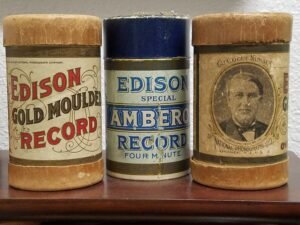
Wax cylinders are extremely fragile. They must be handled with great care. They are also very susceptible to damage by commercial phonograph cleaning solutions. Do NOT use any alcohol, ethylene glycol, or freon-based cleaners. We also do not recommend any of the aqueous-based solutions such as Discwasher or LAST Record Cleaner.
Make up a cleaning solution by using about 3 drops of a mild dish detergent in a quart of tepid water. Use either a new, clean very-fine-bristled paint brush or a new, clean piece of velvet to gently wash the grooves. Wipe along the groove direction, not across the grooves. Rinse thoroughly in running tepid tap water. Finally, rinse with tepid de-ionized or distilled water. Regular tap water has fine minerals in it that will dry on your cylinder. The final rinse with the de-ionized/distilled water will get those mineral deposits off. Let the cylinder air dry in a vertical position.
Oh No, it’s Moldy!
Cylinders that have been attacked by mold may not respond to the above cleaning procedure. We recommend you clean moldy cylinders with the same dish detergent solution, but run in a small ultra-sonic cleaning machine for a 5-15 minute period. Rinse and dry as above. If the mold is severe, even this may not work. Mold is different from dirt. Mold attacks the wax itself, damaging the groove surface and causing permanent noise. Cleaning cannot restore material already consumed by the fungus. Moldy cylinders should be isolated from the rest of the collection, to avoid contaminating the others.
Note: Edison black and gold cylinders should NOT be treated with the LAST Preservative or Record Cleaner.
Some additional advice from the Library of Congress:
Handling Cylinders
- Hold with middle and index fingers, open to a V shape, in the cylinder
- Do not touch the outer, grooved surface (the playing surface) of the cylinder
- Allow wax cylinders from cool storage to acclimate to room temperature before touching to avoid thermal shock
- Store all formats upright: discs and reels on edge; cassettes on long edge; cylinders standing on end
See more advice from IASA (International Association of Sound and Audiovisual Archives)
Related question: Wax cylinders – can I use LAST Preservative on them?